I recently came across a chain of web sites devoted to old computers and the amazing things they can still do today, even though most people just throw them away. The stories made me nostalgic. I started thinking about my experiences with "classic" or "vintage" computers. As with old cars, it can be fascinating and quite entertaining to take an old rig out on the modern streets side-by-side with the newest plastic and sheet-metal creations. I have several "vintage" computers that I like to fire up from time-to-time, to reminisce, or to test backwards-compatibility of my web sites, but that's not what I'm discussing here. I want to relate how it was "back then," before and during the emergence of the Internet. The birth of the Internet really wasn't that long ago, but my experience working with kids who were born in the nineties gives me insight to the perspective of people who have never known a world without the Internet. It makes me feel like an old-timer. This is my story... The basis for the Internet - ARPANet - was created in 1969 (several years before my time), but the World Wide Web emerged into popular culture just as I began to master computers. I was fortunate to be in the right place to tap into the net back when Mosaic, the first web browser, was the only web browser.
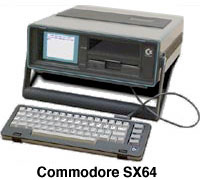
My older brother later got a Commodore
SX-64 when he went off to college. That computer used 5-1/4"
floppy disks, had a built-in 5" color screen, and it was apparently
the world's first portable color computer, although it was the size
of a small suitcase and weighed 23 pounds. At about the time my older brother went off to college, a lot was going on around me in the world of computers, although I must admit that was totally disinterested - lizards were still more fun. In junior high, we were taught to program little bits of BASIC on Apple IIs. I don't think anyone knew what they were doing - we just copied code given to us off a sheet of paper - and the end result was some letters dancing across the screen, or something lame like that. Around the same time, my mother bought a brand new Macintosh to publish her business newsletter (I believe it was the 512k model, though it may have been the original 128k model). I was eleven or twelve at the time, and I recall helping my mother learn to use many of the computer's features, because it seemed so intuitive to me (MacPaint was a lot of fun, but computers were still not very interesting to me). The Commodore SX-64 lived out its days connected to the television
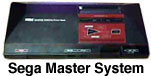
as a rarely-used game machine. I think it's still in the TV cabinet
at my parent's house, along with an old Sega
that a friend gave me when he got a Nintendo.
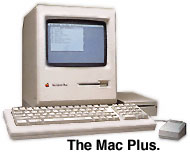
My older brother upgraded to a Mac
Plus as he entered law school. I was studying Mechanical Engineering in college, and computer programming was a part of the requirements. During my sophomore year of college, while living off campus, I was regretfully spending far too many nights in the computer lab, completing my assignments for my Fortran class. In order to work comfortably from home, one of the first things I added to my Mac Plus was a 2400 baud modem. Wow, was that amazing. My computer was no longer an island. It was now a gateway. I could dial into the school network through a terminal session, using a program called Microphone. I could write, debug, compile and run my Fortran programs on the UNIX server, all from the comfort of my bedroom several miles from campus. I could connect to Bulletin Board Systems around the world. I could download software from FTP sites. This was in January of 1993. I had no exposure to all this stuff, except from fantasy movies like War Games (Matthew Broderick, 1983). There were plenty of people out there who had modems, just nobody I had ever met. This was cutting edge stuff at the time. 1993 was the year of the Internet. The foundations for the network were laid in the early seventies, but the Internet as we know it today was a private affair for governments, large financial institutions and major universities. It wasn't until 1993 that InterNIC was formed to provide Internet registration services, and companies started selling connections to individuals and private businesses. Anyone could get on the Internet, and the first graphical web browser, NCSA Mosaic, whose authors subsequently founded Netscape, was released for free, making the vast quantities of data linked on the World Wide Web easily accessible by anyone who could point and click. Internet usage exploded, with a 341,634% increase in traffic from the prior year (reference). One of my engineering professors in 1993 arranged for my class to attend a seminar in the university library that introduced us to the World Wide Web. I was blown away. Relative to today, the Internet was quite primitive (no SPAM, no banner ads), but even then the amount of information available was staggering. We were using NCSA Mosaic at first, and Netscape 1.0 later that year at the research lab I worked at. I was totally unaware of the enormous cultural awakening that was beginning to take place. I didn't learn the history of the Internet until 1999, when I became a computer teacher. The following year, I still used my Mac Plus for dialing into the school UNIX servers and the occasional BBS, but TCP/IP (the Internet Protocol) was nowhere to be found on that machine. By this time I had also upgraded my Mac Plus to a whopping 4MB of RAM (which involved clipping a resistor on the motherboard). Netscape was available freely for non-commercial applications, as was the other software I needed for my Mac to get on the Internet, so I went to the Academic Computing Services office, 800k floppy disks in hand, and they loaded me a copy of Config/PPP and MacTCP. I went home and banged my head against the wall, thinking, what the f$@% is a subnet mask? a class what address? a domain name server? Eventually I figured it all out, and was cruising the Net on my Mac Plus at a blazing 2400bps. Yeah, baby! This was 1994. By now the public Internet was only a year old, but my Mac Plus was already an ancient dinosaur, with its 8MHz processor, compared to the amazing new Pentium 90MHz that came out that year. By this time, I was using computers heavily in my engineering classes and at work. I wanted to run AutoCAD at home for my mechanical design classes, and the Mac Plus could never handle AutoCAD with its 9" monochrome display. Apple had fallen on dark times in 1995. Their 40MHz Motorola 68040 (CISC) processors couldn't keep up with IBM-PC clones, so they switched their entire product line over to an entirely new architecture developed by the AIM Alliance, called PowerPC. AIM was the Apple, IBM and Motorola Alliance. PowerPC chips were based on a more modern architecture (RISC) than the older chips, giving them a great speed advantage when running native PPC code. However, except for fractal demos, native applications didn't exist yet, so the PPC machines were much slower in real-world operation, having to emulate old 68LC040 chips (the "LC" meaning that PPC chips don't emulate the math coprocessor of the 68040 chip). Without any way of emulating the 68040 math coprocessor, the PPC was awful at running the Macintosh version of AutoCAD. The older generation of 68040 chips, although technically slower, ran most software much faster, since they needed no emulation layer. Sadly, AutoCAD for the Mac was never updated for the PowerPC and is now discontinued. These were dark times, indeed... And there I was, in the market for a new computer. The logical thing to do would be to buy a 486DX4/100, which was less expensive than the new Pentium, but just as fast. I even had some guy who custom-built systems come to my house to demo one for me. I wasn't impressed. From that point forward, I never took my Mac Plus for granted again. The Macintosh had accomplished in 1984 what the DOS/Windows world has yet to accomplish. This isn't a story about evangelizing Macs. There are plenty of other web sites that do that. I'm just sharing my personal experiences. I used DOS/Windows every day at work and in many of my classes. I also used UNIX workstations. I maintained the Macs and IBM-PC clones at work. It wasn't a question of what I knew best. The question was, "what platform allows me to get the most work done in the least amount of time?" The answer wasn't so simple. I ended up buying an intriguing little pizza box-sized machine called the Power Macintosh 6100/66/DOS Compatible. It allowed me to keep all my Mac files and also let me run PC software natively (no emulation) on a card that had a 486/66MHz chip on it. It shared the Mac's monitor and a portion of its hard drive. I eventually sold that machine and replaced it with an 8100/100 with a 5x86/133MHz "DOS on Mac" card inside it... Computers have come a long way in terms of raw power. In terms of capabilities, however, very little has changed since the days when I was surfing the net on my little 8 Mhz Mac Plus. There's not much that I can do now that I couldn't do back then, albeit much slower. Then again, there are DVDs, color graphics, MP3s... Someday, though, these too will seem as old-fashioned as my 2400 baud modem seems today. I hope you enjoyed my story. Take Care, Kevin Sites for Vintage Macs:
Sites for Mac Upgrades and Specifications:
|